
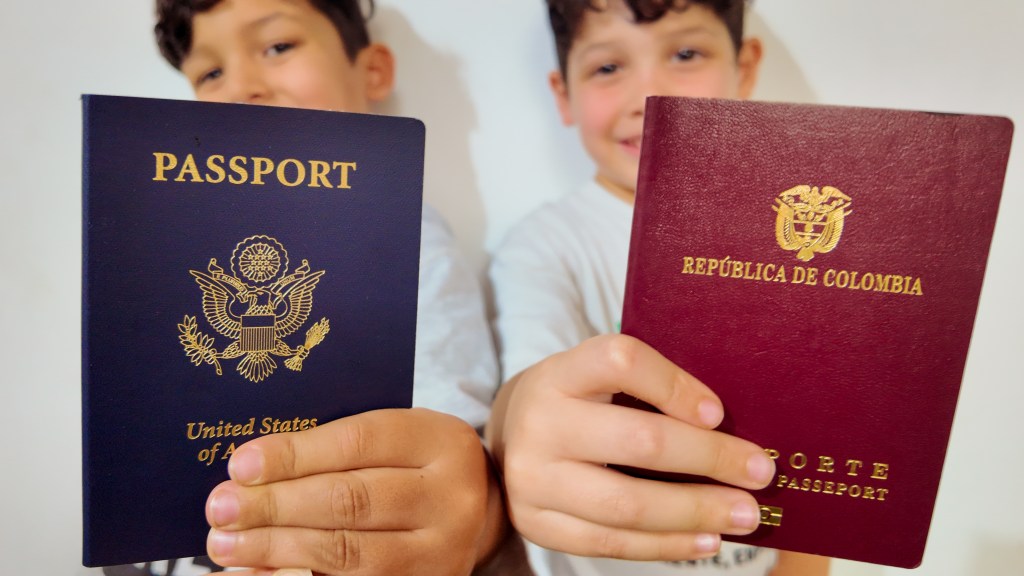
Even before we had kids we knew one thing was certain, we were raising dual citizens. I often joke to my husband that I married him for his Colombian papers! It was always part of the plan to give our kids the world and all the doors open to them, but that doesn’t mean it was exactly easy….
This guide walks you through exactly how to obtain Colombian dual citizenship for your children born outside Colombia, whether you’re doing it from the U.S. through a consulate or in person at a Registraduría in Colombia. I’m covering both paths plus what it means for you as a parent in terms of visas and residency.
Disclaimer: I’m not an immigration lawyer. This is based on our personal experience and research. Laws change, so always confirm with your nearest Colombian consulate or a licensed attorney.
Does My Child Qualify for Colombian Citizenship?
Under Article 96 of the Colombian Constitution, your child is considered Colombian by birth if at least one parent was a Colombian national at the time of the child’s birth. It doesn’t matter where in the world the child was born. As long as a parent holds Colombian nationality, that child has the right to Colombian citizenship by descent (jussanguinis). Colombia does not allow citizenship by birthright.
Colombia also fully allows dual citizenship. Your child does not have to give up their U.S. (or other) citizenship to become Colombian, and being Colombian won’t affect their existing passport. Dual nationality is protected under Colombian law and it cannot be revoked simply because another citizenship was acquired.
If the parent is naturalized Colombian (meaning they weren’t born Colombian but became one later), the path is slightly different. If your child was a minor when you naturalized, they can be included in your naturalization decree, but both parents must request it jointly. If your child was born after you became a naturalized Colombian, the process is the same as for natural-born Colombian parents. If your child was already an adult when you naturalized, they’d need to apply for citizenship independently.
Documents You’ll Need: The Full Checklist
This is where you need to be careful. Every single document has to be right in terms of format, order, certification, etc., or you’ll get sent home. Here’s what you need:
Child’s U.S. birth certificate — must be an original certified copy from the vital records office of the state where the child was born. Not a hospital copy, not a photocopy. The official one with the raised seal. The office will keep this so please make sure you have a copy however, you may want to consider obtaining a new one.
Apostille of the birth certificate — this is issued by the U.S. Secretary of State (either the state-level Secretary of State in the county your child was born or the U.S. Department of State for federal documents). The apostille authenticates the birth certificate for international use under the Hague Convention. Critical: the apostille goes on the original birth certificate FIRST, before any translation.
The reason I mentioned getting a new birth certificate is because some Colombian consulates in the U.S. have decided that the birth certificate and apostille must be signed by the same person! Not every consulate, but it depends on the person attending you. Better be safe than sorry and apply for both at the same time.
Official Spanish translation — after the birth certificate is apostilled, you need it translated into Spanish by a certified translator (traductor juramentado). Not Google Translate, not your bilingual cousin. A sworn, certified translator. The translation covers both the birth certificate and the apostille stamp.
Colombian parent’s cédula de ciudadanía — the original plus a photocopy. Make sure it’s current and not expired.
Parent passports — copies of both parents’ passports (Colombian parent’s Colombian passport and the non-Colombian parent’s passport, if applicable). Yes, even the non-Colombian parent must present their documents to obtain Colombian citizenship.
Marriage certificate — if applicable, with apostille and official Spanish translation following the same order (apostille first, then translate).
Blood type and RH factor — Colombian law requires this for civil registration. You can get it from your child’s pediatrician or a lab.
Proof of domicile — for consular registration, you may need to show proof that you reside in the jurisdiction of the consulate where you’re applying (utility bill, lease agreement, bank statement).
Keep everything organized in a folder. Bring originals AND copies of every single document. If one thing is missing, they will turn you away. If you have multiple children, you will need to make copies of the documents, like marriage certificate and cédula, for each child.
Consulate Abroad vs. Registraduría in Colombia
You have two options for registering your child’s Colombian birth: do it at a Colombian consulate in the country where you live, or do it in person at a Registraduría Nacional office in Colombia.
Registering at a Colombian Consulate (Outside Colombia)
This is the most common route for families living in the U.S. Here’s how it works:
Step 1: Find your consulate. Go to cancilleria.gov.co and locate the Colombian consulate that covers your jurisdiction.
Step 2: Book an appointment. Most consulates now require advance online scheduling. Walk-ins are rarely accepted. Book early because wait times can be weeks, sometimes months, depending on the consulate.
Step 3: Attend your appointment with ALL documents listed above. Both parents should attend if possible, especially if unmarried (some consulates require both parents present to sign).
Step 4: The consulate processes the birth registration (inscripción de nacimiento). This creates a Colombian civil birth record (registro civil de nacimiento) for your child.
Step 5: Once registered, you can then apply for your child’s Colombian cédula de ciudadanía (if over 18) or tarjeta de identidad (ages 7-17), and their Colombian passport.
Timeline: Typically 1-2 business days.
Cost: The birth registration itself is free. Passport and cédula have separate fees.
Registering at the Registraduría in Colombia
If you’re already in Colombia or planning a trip, you can register directly at any Registraduría Nacional office.
Process: Essentially the same documents, same registration. You’ll go to a Registraduría office, present your apostilled and translated documents, and they’ll create the civil birth record on site.
Advantages: The process is generally faster in person, and you receive the civil registry same day (Unless you’re us! More on that later).
Disadvantages: You need to physically be in Colombia. If any document is wrong, you can’t easily fix it from abroad. And if you’re registering late (more than one month after birth), it’s classified as registro extemporáneo (late registration), which may require additional documentation or an appointment in advance.
Which Should You Choose?
If you’re living in the U.S. and not planning a Colombia trip soon, do it at the consulate. It’s designed for families abroad and the process is streamlined for your situation.
If you’re already living in or traveling to Colombia, the Registraduría can be faster and more direct but make sure every document is already apostilled and translated before you arrive. You don’t want to be scrambling for a traductor juramentado in a new city with a toddler in tow. Ask us how we know.
Learn From Our Mistakes
We made every mistake you can make with this process, and we documented them so you don’t have to repeat them. We break it all down in our YouTube video: Colombian Dual Citizenship for Children: Step-by-Step (Avoid Our Costly Mistakes).
Mistake #1: [Apostille timeline] — We should have gotten the documents apostilled before we left. The only reason we didn’t is we were told that the apostille needs time to be done within 3-6 months. That was false, they don’t expire! Instead, we ended up doing the process from abroad through UPS and it cost us $175 per document.
Mistake #2: [Wasted trips] — We showed up to the registraduría without an appointment and it was a lot of back and forth to get one. First, we had to go to el Centro to get the appointment for a satellite office except, it was elections and appointments were paused for 2 weeks! Make sure there aren’t any holidays that might slow down the process.
Mistake #3: [My name as the parent not matching one birth certificate] — This one threw me for a loop! All my life I had a middle name, except, I didn’t! It was on my bank account, driver’s license, and old passport, but my birth certificate? Nope! Imagine my surprise when my middle name was on my oldest son’s birth certificate, but not even my own. The office didn’t accept that I am the same person! Luckily, my mom had my baptism certificate with this so-called middle name and they accepted that.
Point is, your documents need to match EXACTLY!
What Colombian Citizenship Means for Parents
Here’s something a lot of families don’t realize: once your child is officially registered as a Colombian citizen, it opens a door for you as a parent too.
Visa M — Parent of a Colombian National by Birth is a visa category specifically designed for foreign parents of Colombian children. Here’s what it offers:
Duration: Up to 3 years, renewable.
Work authorization: It comes with an open work permit. You can work for any employer in Colombia or freelance.
Path to residency: After holding a Visa M for 2 years, you can apply for a Resident Visa (Visa R), which is essentially permanent residency.
Path to citizenship: After holding the Resident Visa for 2 years (4 years total from your initial Visa M), you become eligible to apply for Colombian citizenship yourself. This is one of the fastest paths to naturalization in the country.
This is huge. For the non-Colombian parent in the family, your child’s citizenship registration doesn’t just give them their nationality, it gives you a legitimate immigration pathway that’s faster than most work or retirement visa routes. It’s even faster than applying through a Colombian spouse!
To apply for the Visa M, your child must already have their Colombian registro civil de nacimiento (civil birth record) completed. That’s why getting the citizenship registration done first is so important.
Timeline: What to Expect From Start to Finish
Here’s a realistic timeline based on our experience and what we’ve heard from other families:
Getting documents together (U.S. side): 2 to 4 weeks — ordering certified birth certificates, getting the apostille, finding a certified translator.
Consulate appointment wait: 2 to 8 weeks — depends heavily on which consulate and time of year.
Registration processing: days after your appointment.
Colombian passport application: Once the registro civil is issued, you can apply for the child’s passport. Processing time varies, some consulates do it in 2 weeks, others take up to 2 months.
Total realistic timeline: 2 to 5 months from start to passport in hand.
Start early. Don’t wait until you need the passport for a trip. Give yourself at least 4 to 6 months of runway.
Frequently Asked Questions
Can my child born in the U.S. get Colombian citizenship? Yes, if at least one parent was Colombian at the time of birth, your child qualifies for Colombian citizenship by descent, regardless of where they were born.
Does Colombia allow dual citizenship for children? Absolutely. Colombia fully recognizes dual nationality. Your child can hold both U.S. and Colombian citizenship with no conflict.
What if I register my child “late”? It becomes a registro extemporáneo (late registration), which may require additional steps, but it’s basically what we did for our kids as they were 4 and 6 at the time of their registro.
Do I need a lawyer for this process? Not necessarily. Many families complete the process on their own through the consulate. However, if your situation is complex or you’re unsure, consult with a Colombian immigration attorney.
How much does Colombian citizenship registration cost? The civil birth registration itself is free at both consulates and registraduría offices. You’ll pay separately for the passport and any translation/apostille services.
Can parents apply for the Visa M once the child(red) are citizens?? Yes either parent (or legal guardians) of a Colombian child can apply for the Visa M. Consul with a Colombian immigration attorney, like Maria Jose Gonzalez Giraldo of Law Colombia. She has been helping me and mention Alyssa sent you!
Final Thoughts
Getting your child dual citizenship is one of the most meaningful things you can do for their future. It’s not just about giving them legal roots in a country, it’s about identity and belonging. It opens doors for them and for you. It gives them options, access, and a connection that goes beyond a vacation in the homeland.
Yes, the process has its headaches. But once that registro civil is in your hands and you’re holding your child’s Colombian passport vale la pena. It’s worth every hurdle and we would do it again to get the result!


Leave a Reply